Chokepoints for Hire: How Foreign-Controlled Logistics Infrastructure Is Embedding Blind Spots Into America's Supply Chain
The Invisible Architecture of Commercial Dependency
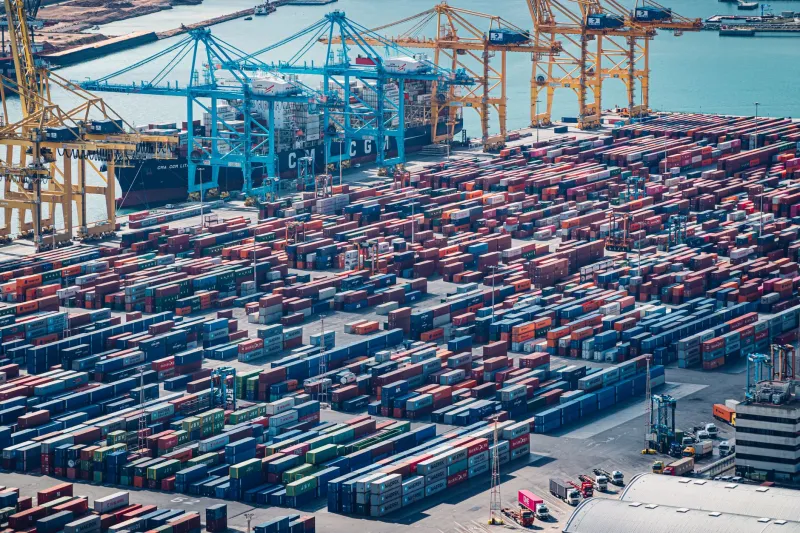
Every container that arrives at an American port carries with it a chain of custody stretching back through dozens of intermediaries — freight forwarders, transshipment terminals, third-party logistics providers, and port operators whose ownership structures are rarely scrutinized by the businesses that depend on them. That opacity is not accidental. For strategic competitors, it represents a carefully cultivated condition.
Over the past two decades, state-affiliated enterprises from China, Russia, and several Gulf-linked investment vehicles have methodically acquired or established operational positions within the global logistics infrastructure that services American import and export flows. These positions do not require military assets or covert operatives. They require only routine commercial access — and the patience to exploit it.
The strategic logic is straightforward. A logistics hub that processes cargo destined for U.S. ports generates intelligence on commodity flows, defense-related shipments, and the operational rhythms of American industry. A terminal operator with contractual authority over transshipment routing carries the latent ability to delay, divert, or manipulate cargo under conditions of crisis. Neither capability announces itself. Both are embedded in the ordinary paperwork of global trade.
Mapping the Exposure
The vulnerability is not confined to any single geography. It is distributed across the transshipment nodes that American supply chains cannot easily avoid — ports in Panama, the Bahamas, Sri Lanka, Djibouti, and across the Mediterranean littoral where Chinese state-owned shipping enterprises have acquired terminal concessions or majority stakes in port operating authorities.
COSCO Shipping Ports, a subsidiary of China's state-owned shipping conglomerate, holds terminal interests in more than two dozen countries. Hutchison Ports, a Hong Kong-based operator with documented ties to Chinese state interests, controls facilities at both ends of the Panama Canal — a chokepoint through which roughly 40 percent of U.S. container traffic passes. Although a 2025 agreement signaled potential changes to Hutchison's Canal-adjacent holdings, the broader ecosystem of Chinese logistics positioning across the Western Hemisphere remains largely intact.
The concern extends beyond port terminals. Third-party logistics providers — companies that manage warehousing, customs brokerage, freight forwarding, and last-mile delivery on behalf of American importers — represent an equally significant vulnerability. Many of these firms operate as subsidiaries or joint ventures of foreign parent companies whose ultimate beneficial ownership is obscured through layered corporate structures registered in permissive jurisdictions. American customs and border protection authorities screen cargo. They rarely screen the organizations that orchestrate its movement.
Where Screening Stops and Exposure Begins
U.S. Customs and Border Protection's Automated Targeting System applies risk scores to inbound cargo based on manifest data, shipper history, and intelligence inputs. The Container Security Initiative extends that screening to select foreign ports. The Customs-Trade Partnership Against Terrorism program certifies supply chain security practices among participating importers.
These mechanisms were designed to detect contraband, weapons, and terrorist-linked shipments. They were not designed to identify the strategic intelligence value of cargo movement data, nor to assess the geopolitical affiliations of the intermediaries who handle that cargo before it reaches American waters.
A foreign-controlled freight forwarder operating lawfully in a transshipment hub can observe the cadence of defense contractor shipments, identify patterns in rare earth mineral imports, or monitor the logistical signatures of military procurement cycles — all without triggering a single alert in any existing screening architecture. The data generated by routine commercial logistics is, in aggregate, a detailed map of American industrial and strategic activity. That map is accessible to anyone positioned within the network.
The Transshipment Leverage Problem
Beyond intelligence collection, the more acute concern among security analysts involves the potential for supply chain manipulation under conditions of strategic escalation. A state actor with operational influence over a critical transshipment node does not need to physically intercept cargo to create disruption. Bureaucratic delay, rerouting to less efficient corridors, selective application of inspection protocols, or the quiet prioritization of competitor cargo during periods of high port congestion can all impose meaningful costs on American importers without constituting an act of aggression that triggers a formal response.
This is gray zone economics — the application of commercial leverage to achieve strategic effects below the threshold of overt conflict. It is deniable, scalable, and extraordinarily difficult to attribute. And it operates through the same commercial relationships that American businesses have spent decades optimizing for cost efficiency rather than resilience.
The Panama Canal illustration is instructive. During any future crisis involving Taiwan, the South China Sea, or direct U.S.-China economic confrontation, American policymakers would face the immediate question of whether critical logistics infrastructure in their own hemisphere could be relied upon to function without interference. The answer, under current conditions, is not reassuring.
Regulatory Gaps and the Ownership Opacity Problem
The Committee on Foreign Investment in the United States (CFIUS) reviews foreign acquisitions of American businesses for national security implications. Its jurisdiction does not extend to foreign companies acquiring logistics infrastructure in third countries — even when that infrastructure is deeply integrated into American supply chains. The result is a regulatory perimeter that protects the domestic end of the supply chain while leaving the international architecture largely unexamined.
Port security legislation, most recently updated through the Maritime Transportation Security Act framework, focuses on physical security at U.S. facilities. It does not create mechanisms for assessing the strategic ownership profiles of overseas operators whose facilities handle American cargo. Congress has shown periodic interest in this gap — particularly following scrutiny of Chinese port equipment manufacturers like ZPMC, whose cranes dominate American port infrastructure — but comprehensive ownership transparency requirements for foreign logistics intermediaries have not materialized.
The Biden administration's 2024 executive action directing a review of Chinese-manufactured port cranes and associated software represented a meaningful acknowledgment that logistics infrastructure carries embedded intelligence risk. It also illustrated how narrowly the problem has been framed. Cranes are visible. Ownership structures are not.
Toward a Logistics Security Framework
Addressing this vulnerability requires a conceptual expansion of what constitutes critical infrastructure risk. The physical port is only the final node in a network whose earlier links are equally consequential. A serious policy response would require mandatory beneficial ownership disclosure for third-party logistics providers operating within U.S. supply chains above defined thresholds, extended CFIUS-equivalent review authority for foreign acquisitions of transshipment infrastructure in strategically significant locations, and intelligence-community integration into supply chain certification programs that currently rely exclusively on commercial self-reporting.
None of these measures would eliminate the dependency that decades of cost-optimized globalization have created. They would, however, make the exposure visible — which is the precondition for managing it.
For security professionals and policymakers tasked with assessing national resilience, the logistics network is not a background condition. It is a threat surface. And unlike most threat surfaces, it processes trillions of dollars in commerce every year while receiving a fraction of the scrutiny applied to far less consequential vulnerabilities.