America's Maritime Underbelly: Assessing the Compounding Risks Threatening Critical Port Infrastructure
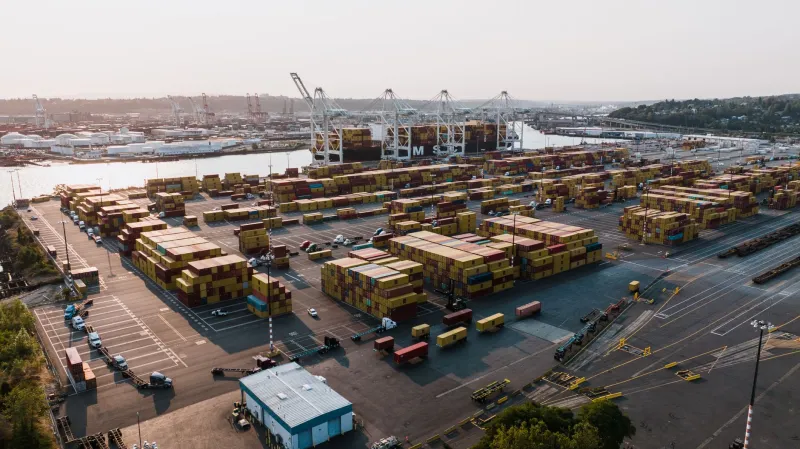
The United States moves approximately $1.6 trillion in goods through its commercial port system annually. The same infrastructure that clears consumer electronics through the Port of Los Angeles also supports the rapid deployment of military equipment, pre-positioned fuel stocks, and the global supply chains that sustain defense manufacturing. When that infrastructure is disrupted — whether by a Category 4 storm, a ransomware attack on terminal operating systems, or a deliberate campaign of foreign interference — the consequences extend well beyond delayed cargo manifests.
What has emerged in recent years is a dual threat architecture that security analysts are only beginning to assess in its full complexity: physical infrastructure degraded by decades of underinvestment and accelerating climate stress, intersecting with a documented and growing effort by rival powers to map, probe, and potentially exploit American port vulnerabilities. Understanding where these two threat vectors overlap — and which facilities sit at the most dangerous intersection — is now a core intelligence requirement for defense planners and port security professionals alike.
The Infrastructure Baseline: A System Under Strain
The American Society of Civil Engineers has consistently graded US port infrastructure in the C-range, a designation that translates operationally into aging crane systems, outdated flood barriers, deteriorating berth structures, and terminal technology that in many cases predates the cybersecurity threat landscape that now surrounds it. The Biden administration's $17 billion port investment package, announced in 2023 as part of broader infrastructure legislation, acknowledged the scale of the backlog — but funding disbursement timelines mean that many facilities will remain structurally exposed through the end of the decade.
Climate-driven stress compounds this baseline vulnerability in ways that are both measurable and accelerating. Ports along the Gulf Coast — including the Port of Houston, which handles more foreign waterborne tonnage than any other US facility — face intensifying hurricane seasons that stress infrastructure designed to earlier meteorological standards. Ports in the Pacific Northwest contend with seismic risk and rising sea levels that threaten low-elevation terminal facilities. On the East Coast, tidal flooding events that were once statistically rare are now occurring with sufficient frequency to affect operational planning at facilities from Baltimore to Savannah.
None of these are hypothetical scenarios. Hurricane Harvey's 2017 impact on the Houston Ship Channel — which remained closed for eleven days — cost an estimated $800 million in direct and indirect economic losses and disrupted petrochemical supply chains with downstream effects on defense-related manufacturing.
Foreign Interference: Mapping the Threat Actors
Physical vulnerability would be manageable in isolation. What elevates the strategic risk profile is the documented interest of adversarial states in exploiting precisely these weaknesses.
China's position in US port infrastructure is the most extensively documented concern. ZPMC, the Chinese state-affiliated manufacturer, supplies the majority of ship-to-shore cranes operating at American ports — equipment that US defense officials have publicly identified as potentially containing embedded communications hardware capable of transmitting operational data to external parties. The House Select Committee on the Chinese Communist Party released findings in 2023 confirming that ZPMC cranes at multiple US military-adjacent ports contained modems not reflected in manufacturer documentation.
This is not an isolated procurement concern. It reflects a broader strategic logic: by embedding technological dependencies at critical logistics nodes, a rival power acquires both intelligence collection capabilities and, potentially, the ability to degrade port operations during a period of strategic competition or conflict — without ever deploying a conventional military asset.
Russia's approach has been less infrastructural and more operational, focusing on information operations that target labor relations at major ports and disinformation campaigns designed to amplify economic disruption during existing crises. Iranian-linked actors have demonstrated interest in maritime cybersecurity vulnerabilities, particularly targeting vessel tracking and port management systems.
A Tiered Vulnerability Framework
Not all ports carry equal strategic weight, and effective resource allocation requires a framework for distinguishing between facilities whose disruption would be operationally significant and those whose loss, while costly, would be recoverable through alternative routing.
At the highest tier of strategic concern sit facilities that serve dual commercial-military functions with limited redundancy. The Port of San Diego, adjacent to one of the largest concentrations of US naval assets in the world, and the Port of Beaumont in Texas — which the Military Traffic Management Command has identified as the nation's leading military cargo port — represent facilities where disruption would carry immediate defense readiness consequences.
A second tier encompasses ports whose commercial throughput is so concentrated that disruption would cascade rapidly through supply chains with defense implications. The Ports of Los Angeles and Long Beach together handle approximately 40 percent of US containerized imports. A sustained closure — whether from a climate event, a cyberattack on terminal operating systems, or labor action exacerbated by foreign information operations — would affect everything from semiconductor availability to medical supply chains that support military healthcare logistics.
A third tier includes facilities that are individually less critical but whose geographic clustering creates regional concentration risk. The Gulf Coast petrochemical port complex — Houston, Beaumont, Port Arthur, and Lake Charles — functions as an integrated system. Disruption at multiple nodes simultaneously, a scenario that a well-designed adversarial campaign might target, would stress military fuel supply chains in ways that individual facility assessments do not capture.
Detection, Deterrence, and Resilience Investment Priorities
For security professionals advising port authorities, federal stakeholders, or defense contractors dependent on maritime logistics, several priority areas emerge from this threat mapping exercise.
Technology Auditing and Supply Chain Verification: Port operators must conduct systematic audits of all networked infrastructure — particularly crane systems, terminal operating software, and vessel tracking technology — for components sourced from adversarial-state manufacturers. The Coast Guard's 2024 executive order authority over maritime cybersecurity provides a regulatory framework, but implementation requires facility-level technical expertise that many port authorities do not currently maintain in-house.
Redundancy Planning and Alternate Routing Protocols: Facilities in the highest vulnerability tier should maintain current, exercised plans for cargo diversion to alternate ports. These plans must account for the capacity limitations of receiving facilities and the transit time implications for time-sensitive military cargo.
Climate Resilience as a Security Investment: Flood barrier upgrades, berth reinforcement, and backup power infrastructure are not merely capital improvement projects — they are threat mitigation measures that reduce the attack surface available to adversaries seeking to exploit climate-driven disruptions. Framing these investments within a national security context strengthens the case for federal funding prioritization.
Information Sharing Frameworks: The Transportation Security Administration's Surface Division and the Coast Guard's Maritime Intelligence Fusion Centers provide mechanisms for sharing threat intelligence with port operators, but participation remains inconsistent across the sector. Expanding mandatory information sharing requirements — particularly for facilities with defense cargo designations — would meaningfully improve the collective threat picture.
Conclusion: The Map Reveals the Risk
The strategic logic of targeting port infrastructure is straightforward: it is expensive to harden, difficult to fully redundantize, and essential to both economic function and military projection. Adversaries who have studied American power understand that the logistics layer is where strategic competition can be waged below the threshold of armed conflict.
The compounding interaction of climate stress and deliberate interference is not a future scenario. It is a present condition. The facilities most at risk are identifiable, the threat actors are documented, and the policy tools — while imperfect — exist. What has been lacking is a systematic, intelligence-driven approach to mapping where the vulnerabilities are greatest and directing resources accordingly.
That mapping work is now, unambiguously, a national security imperative.