Africa's Shadow Wars: How Competing Powers Are Exploiting the Continent's Conflicts While Washington Struggles to Keep Pace
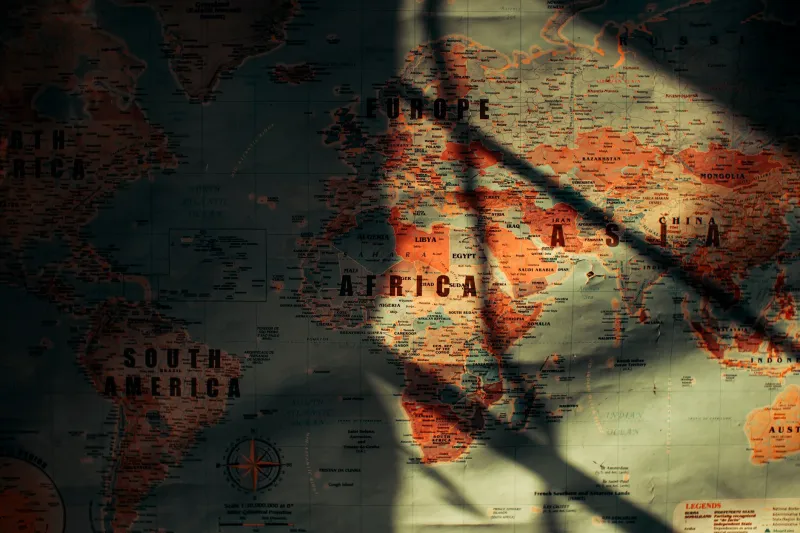
A Continent Remapped by Competition
For much of the past two decades, Africa occupied a secondary tier in American strategic planning—a region associated with humanitarian crises, counterterrorism operations, and development assistance rather than great power rivalry. That calculus has fundamentally changed. Today, the continent is a primary arena where Russia, China, the Gulf states, Turkey, and an array of non-state armed networks are actively contesting influence, testing military capabilities, and establishing logistical footholds that carry long-term strategic consequences.
What makes the current moment particularly difficult for Western analysts is not simply the volume of competing actors. It is the deliberate opacity with which they operate. Unlike the Cold War proxy conflicts that unfolded in Angola or Mozambique—conflicts that, despite their complexity, involved relatively legible superpower sponsorship—today's African battlespaces feature layered, often overlapping relationships between governments, mercenary contractors, commercial entities, and armed factions. The result is a threat environment that resists the kind of clean attribution and predictive modeling that American intelligence architecture was designed to produce.
The Sahel as Strategic Laboratory
No region better illustrates this dynamic than the Sahel, the semi-arid belt stretching across West and Central Africa that has become, in the span of roughly a decade, one of the most consequential conflict zones on the planet. The withdrawal of French forces from Mali, Burkina Faso, and Niger following a series of military coups has created a power vacuum that outside actors have moved quickly to fill.
Russia's Africa Corps—the rebranded successor to the Wagner Group following Yevgeny Prigozhin's death in 2023—has embedded itself within the security structures of multiple Sahelian governments. Beyond providing direct military assistance, the organization functions as an intelligence-collection network, a disinformation amplifier, and an extractive economic actor simultaneously. Russian-linked entities have secured access to gold mines, uranium deposits, and agricultural concessions in exchange for security guarantees. That transactional model is not incidental to the strategy; it is the strategy.
Chinese engagement in the region operates along a different but equally consequential axis. Beijing's approach prioritizes infrastructure investment, port access, and diplomatic normalization over direct military involvement—though the People's Liberation Army's expanding logistics network on the continent increasingly blurs that distinction. Chinese-built roads, rail lines, and communications infrastructure in conflict-affected regions serve dual purposes that American policymakers have been slow to fully incorporate into their threat assessments.
Fragmented Data, Fractured Analysis
The core analytical challenge confronting American intelligence agencies is not a shortage of raw information. Signals intelligence, commercial satellite imagery, open-source reporting, and partner-nation liaison channels collectively generate enormous volumes of data on African conflict dynamics. The problem is synthesis. The US Africa Command (AFRICOM), headquartered in Stuttgart, Germany—itself a geographical anomaly that reflects longstanding ambivalence about prioritizing African security—operates with a comparatively lean analytical footprint relative to the breadth of its area of responsibility.
When simultaneous crises erupt across Sudan, eastern Democratic Republic of Congo, northern Mozambique, and the Sahel corridor, the institutional capacity to connect those data streams into a coherent, actionable intelligence picture is severely strained. Each crisis generates its own reporting chain, its own set of country-desk analysts, and its own interagency stakeholders. The lateral connections—the ways in which arms shipments flowing through one conflict influence militia financing in another, or how a mercenary contractor's presence in one country shapes a neighboring government's strategic calculations—tend to fall through the analytical gaps.
This fragmentation is not merely an organizational inconvenience. It has direct policy consequences. American responses to African crises have repeatedly been characterized by reactive posture: sanctions announced after influence has already been consolidated, diplomatic initiatives launched after relationships have already been foreclosed, and military assistance programs initiated after security vacuums have already been filled by rival actors.
Emerging Flashpoints Demanding Sustained Attention
Several specific zones merit elevated attention from security professionals and policymakers monitoring the African theater in the near term.
Eastern DRC remains one of the most kinetically active and analytically underserved conflict environments on the continent. The M23 rebel movement, backed by Rwanda, controls significant territory in North Kivu province while multiple other armed factions—some with documented links to external state sponsors—operate simultaneously. The humanitarian catastrophe has drawn international attention; the geopolitical architecture driving it has received considerably less rigorous analysis.
Sudan has descended into a conflict between the Sudanese Armed Forces and the Rapid Support Forces that, by mid-2024, had displaced millions and attracted external military support from multiple directions. The UAE, Egypt, Russia, and Iran have all been identified as having varying degrees of involvement in the conflict. Sudan's geographic position—bordering the Red Sea, Libya, Ethiopia, and Chad—gives the conflict's outcome outsized regional significance.
The Gulf of Guinea presents a maritime dimension that complements the land-based threat picture. Piracy networks, illicit commodity flows, and competing naval access agreements are reshaping the security environment in ways that affect both American commercial interests and the broader Indo-Pacific strategic competition.
The Innovation Dimension
African conflict zones are also functioning as testing environments for military technologies and tactics that will shape future warfare. Russian forces have refined drone deployment and electronic warfare tactics in the Sahel and Libya. Armed non-state groups have demonstrated sophisticated use of commercial drone platforms for reconnaissance and strike operations at a fraction of the cost of conventional military systems. These are not isolated experiments—they are iterative development cycles with implications that extend well beyond the African continent.
The United States has itself conducted drone-based counterterrorism operations across Africa for years, but the proliferation of these capabilities to a widening array of actors—state and non-state alike—is generating a competitive environment that American military planners must account for in future operational planning.
Closing the Intelligence Gap
Addressing the structural blind spots in American Africa policy requires more than increased funding for AFRICOM or expanded satellite tasking. It demands a fundamental rethinking of how the intelligence community organizes its analytical capacity around complex, multi-actor, geographically diffuse threat environments.
Partner-nation intelligence relationships across Africa have historically been inconsistent and, in some cases, counterproductive, as coups have repeatedly installed governments hostile to prior security cooperation arrangements. Building more resilient, institution-level partnerships—rather than relationships dependent on individual leaders or governments—offers one avenue for improving ground-level information collection.
Equally important is investment in open-source intelligence infrastructure capable of processing the African-language media, social network data, and commercial transaction records that increasingly constitute the primary evidence base for understanding conflict dynamics in real time.
Africa is no longer a secondary theater in global power competition. The powers that recognize that fact earliest—and build the analytical infrastructure to act on it—will hold a meaningful advantage in the strategic contests that define the coming decades. For American policymakers, the window for proactive positioning is narrowing.